

The Self Contemplating Who You Really Are


What are your fundamental beliefs regarding human nature?? We are, essentially selfish and aggressive or have you had personal experiences that go against this opinion? How would your view of yourself change if you accepted the idea that it is inherent to your core Self to be good?, you knew, brave, compassionate, happy and calm? Take a few minutes to imagine how different your life would be if you had greater access to these qualities every day and trusted that this calm Self, happy would correspond to your authentic identity.
Think about how your relationships with key people in your personal life would change., in your work or school life as well as in the decisions you could make in the future.
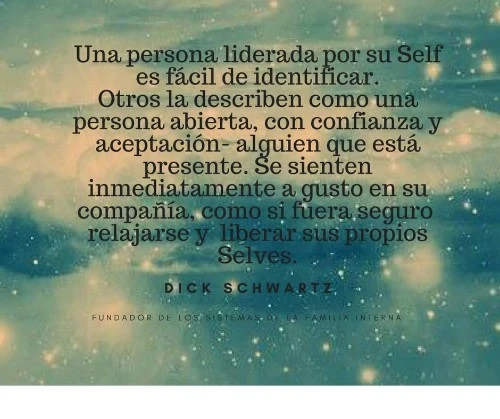
Consider for a moment the idea that your thoughts and emotions come from different aspects or subpersonalities within you.. What fears arise when you contemplate this possibility?? We usually have fears associated with conditions such as schizophrenia or multiple personality disorder or the fear that the strange idea would arise that autonomous entities would exist within us so we would not have full control of ourselves.. If you manage to put these fears aside for a few seconds, consider what benefits you would get if you had parts. What would happen if you knew with certainty that your most repulsive and reprehensible thoughts or feelings are not part of the essence of your identity?, but they come from these small parts within you? What if you could exclude shameful feelings you feel toward others?, telling yourself: “There are parts of me that feel that…” instead of: “I feel that…”What would happen if you were fully convinced that these parts are different from your Self and that you, As for that Self, you can help them transform?
The idea that a, in its essence, It's all joy and peace and that, from there, You can express wonderful leadership and healing qualities and experience a sense of being spiritually connected., They are concepts that go against what one has learned about oneself. Regarding human nature there is, throughout our culture, a diversity of beliefs, none of which are overly encouraging. The most obvious of all is the doctrine of Original Sin promoted by much of Western Christianity.. According to this doctrine, as a consequence of the transgression committed by Adam and Eve, humanity has been cursed to be born in sin and to have a base and selfish nature. According to that perspective, our passions would be evidence of our continued sinful state. We must spend a life controlling our passionate emotions and impulses and reminding ourselves of our basic sinful condition.. Although there are many Christians who today have moved away from that position, The effect it has had on existing beliefs about people in Western culture is enormous.. Such beliefs did not exist before Saint Augustine and, In fact, there have been many early Christians who subscribed to the opposite doctrine., which could be called the “Original Blessing”.

Another position that has had enormous influence has been Charles Darwin's theory of evolution.. Darwin's position on human nature, although it is a scientific perspective, It corresponds quite closely with the doctrine of Original Sin. He postulates that our selfish nature is the product of our genes that program us for the fight for survival in a competitive and hostile environment.. These cultural myths of the Fall and “selfish gene” They appear reflected in some of the most influential psychological schools. Such is the case, For example. of the Freudian schools, behaviorists and evolutionists who maintain that all our actions are designed for the purpose of maximizing pleasure or to expand our gene pool or pool. This perception of ourselves as fundamentally selfish or sinful entities has contributed to the adoption of harsh and punitive methods to control both ourselves and others..

Then there is developmental psychology which maintains that our basic nature is a function of the type of parental relationship we have had.. If one has been lucky enough to enjoy a parental relationship “good enough” during certain critical periods of our initial development, then one will emerge from childhood reinforced with a certain degree of “ego strength”. otherwise, must have had bad luck. Until you experience a new corrective parenting relationship with a therapist or significant other, will remain in a deficient and pathological state. This perspective according to which we do have some valuable qualities, It is because these must have been given to us by the outside world, It is another of the most prevalent and influential perspectives. It constitutes the basis of the learning theories that have predominated in our educational system..
We believe that morality, Empathy and respect must be taught to us since these are not inherent to ourselves..
This philosophy teaches us that, to satisfy our needs, we must look for them outside of ourselves; in the same way, has encouraged therapists to try to provide their clients with what they believe they lack, instead of helping them find them within themselves.
This vision of ourselves as beings dependent on the environment, resourceless and ignorant, has led us to search for “expert” suitable that solves our problems and those who help, to assume pedagogical or parental roles.
Richard C. Schwartz, Ph. D. Introduction to the Internal Family Systems model.
To learn more about this wonderful therapeutic model you can go to https://www.selfleadership.org/